
Diagnostics and imaging, all in-house
We do ultrasound, digital X-ray, endoscopy, dental X-ray and laboratory work in-house, with a same-day report, as part of the visit rather than at a separate appointment.
What is on site
Four ways we find out what is wrong
Ultrasound, digital X-ray, endoscopy, dental X-ray, and laboratory testing — all available in-house and integrated into your pet’s care, allowing us to obtain many important diagnostic results during the same visit.
These diagnostic tools help our veterinarians identify the problem and guide treatment. Many tests can be performed and evaluated in-house during the same visit. If another veterinarian has recommended imaging or bloodwork, please call us to discuss availability.
Ultrasound
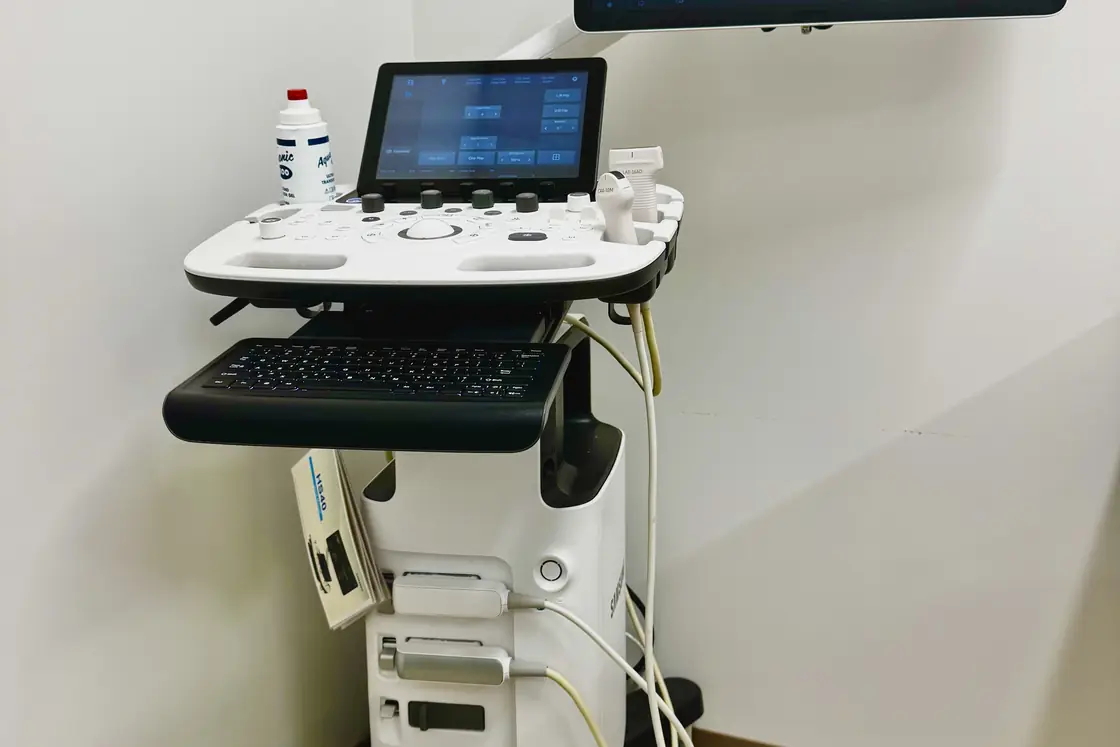
Complete abdominal ultrasound and echocardiography. Real-time imaging of internal organs with no radiation, including ultrasound-guided biopsies and AFAST/TFAST emergency scans of the belly and chest.
Digital X-ray
X-rays of the bones, chest and abdomen, plus dental X-ray to see the teeth below the gumline. X-rays are read in-house by our veterinarian. When needed, images can also be submitted to a board-certified radiologist for consultation or a formal interpretation.
In-house laboratory
Bloodwork and laboratory testing read during the visit, so treatment can start the same day.
Endoscopy
A thin camera used to look inside the body and retrieve objects, avoiding open surgery where it is appropriate to do so.
Ultrasound
Why we often start with ultrasound
Ultrasound is a non-invasive diagnostic tool that uses sound waves to create real-time images of internal organs. It lets our veterinarians evaluate structures such as the liver, kidneys, bladder, spleen and gastrointestinal tract without surgery or radiation.
Benefits:
- Real-time imaging of internal organs
- Non-invasive and generally painless
- No radiation exposure
- Detailed evaluation of soft tissues
- Quick results that help guide treatment
Common uses
What ultrasound is used to evaluate
- Abdominal organs such as the liver, kidneys, bladder and spleen
- Masses, tumors or internal abnormalities
- Fluid in the abdomen or chest
- Heart structure and function
- Ultrasound-guided procedures such as biopsies or fluid sampling
- Emergency evaluation using AFAST and TFAST (quick scans of the belly and chest)
Preparing your pet
Your pet may need to fast for several hours before the procedure. The hair over the examination area may be shaved to improve image quality. Most pets tolerate the procedure well, although mild sedation may occasionally be recommended.
Cardiac
Cardiac Ultrasound & Echocardiography
An echocardiogram provides a detailed look at the heart’s chambers, valves, and function. When a heart murmur or other cardiac abnormality is detected, echocardiography can help identify the underlying cause and guide appropriate treatment and monitoring.
In emergencies, focused cardiac and thoracic ultrasound may also be performed as part of a TFAST examination, helping us rapidly assess for abnormalities such as fluid around the heart or within the chest.
Echocardiography is available in-house, with a visiting cardiologist available on select days for more complex cardiac cases.
Common questions
Questions we are asked
Does my pet need to fast before an ultrasound?
Usually yes — your pet may need to fast for several hours beforehand. The hair over the examination area may be shaved to improve image quality. Call (714) 274-9305 and we will tell you exactly what to do for your pet's appointment.
Is ultrasound painful or does it use radiation?
No. Ultrasound is non-invasive, generally painless and uses no radiation. Most pets tolerate it well, though mild sedation is occasionally recommended for patients who cannot hold still.
How long do laboratory results take?
Our laboratory is in-house, so bloodwork is typically read during the visit rather than sent to an outside lab. That is what allows treatment to start the same day in urgent and emergency cases.
What are AFAST and TFAST?
They are focused ultrasound protocols used in emergency evaluation — a rapid scan of the abdomen (AFAST) or chest (TFAST) to detect free fluid, bleeding or other critical findings.
Schedule diagnostics, or come in now
Call (714) 274-9305 to arrange imaging or laboratory work. For an emergency, come straight to 6937 Warner Avenue, Huntington Beach, CA 92647.
- Address
- 6937 Warner Avenue
Huntington Beach, CA 92647 - Hours
- Monday – Saturday, 9 AM – 8:30 PM · Tue to 6 PMSunday: closed.
- Phone
- (714) 274-9305